
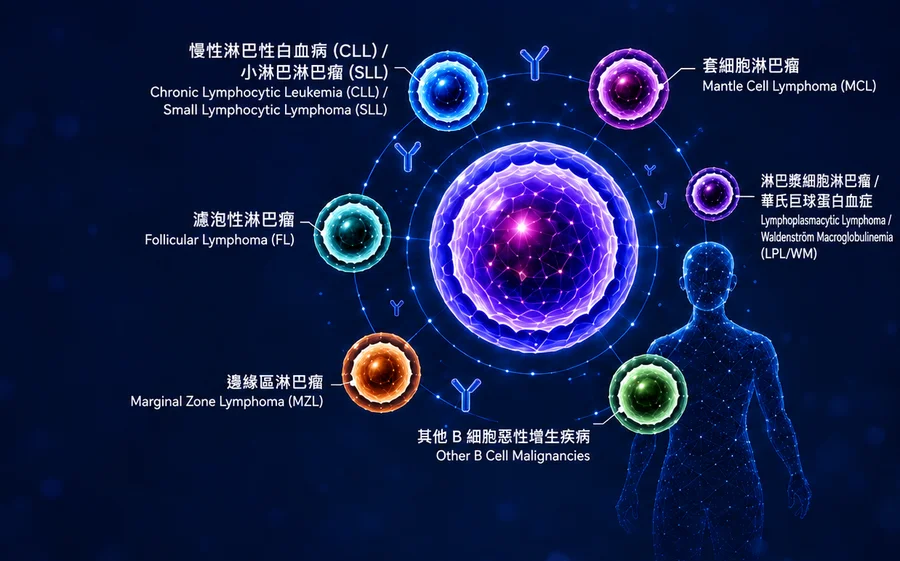
High Sensitivity
Detect rare abnormal B cells
Comprehensive B Cell Profiling
Identify various B cell malignancies
Disease Classification
Support differential diagnosis and subclassification
Treatment Monitoring
Assess minimal residual disease (MRD)
Personalized Healthcare
Guide treatment decisions and long-term management
Indications
Patients with suspected B cell malignancies
(e.g., CLL, lymphoma, plasma cell disorders)
Abnormal blood counts, lymphocytosis, or lymphadenopathy of unknown cause
Monitoring treatment response and disease progression
High-risk groups or family history of hematologic malignancies
Test Contents
Multiparameter flow cytometry to analyze the phenotype of B cells and detect abnormal clonal B cell populations.
| Markers | |
|---|---|
| CD45 | CD38 |
| CD19 | κ (Kappa) |
| CD20 | λ (Lambda) |
| CD5 | CD3 (T cell marker) |
| CD10 | CD14 (Monocyte marker) |
| CD23 | CD56 (NK cell marker) |
Test Workflow

Blood Collection (EDTA)
Peripheral blood sample

Sample Preparation
Cell separation and processing

Staining and Labeling
Multiparameter fluorescent antibody staining

Flow Cytometry Acquisition and Data Analysis

Report Generation
Professional interpretation and report delivery
Multicolor Flow Cytometry Examples
CD19 (B Cells)
CD5
CD23
κ / λ Light Chain Restriction
B Cell Malignancy Immunophenotype Guide
| Disease Type | Typical Immunophenotype Pattern (Partial) |
|---|---|
| CLL/SLL | CD19+ CD5+ CD23+ CD10- CD20dim/weak κ/λ restricted |
| MCL | CD19+ CD5+ CD23- CD10- CD20bright CD38+ κ/λ restricted |
| FL | CD19+ CD10+ CD5- CD23- CD20+ κ/λ restricted |
| MZL | CD19+ CD5- CD10- CD23+/- CD20+ κ/λ restricted |
| LPL/WM | CD19+ CD5- CD10- CD23- CD20+ CD38+ κ/λ restricted |
| Other B Cell Malignancies | Interpretation based on clinical context and additional laboratory findings |
Clinical Value
Early detection of B cell hematologic malignancies
Assist in differential diagnosis
Disease classification and prognostication
Monitoring treatment response and MRD
Guiding personalized treatment strategies
Key Features
- Multiparameter flow cytometry for precise B cell profiling
- Detects light chain restriction (κ/λ) for clonality assessment
- Helps identify common B cell hematologic malignancies
- Supports disease classification and treatment monitoring
- Useful for minimal residual disease (MRD) monitoring
Test Specifications
- Sample Type: Peripheral blood (EDTA, 5–10 mL)
- Method: Multiparameter flow cytometry
- Turnaround Time: 7–10 business days
- Applicable Age: Adults and children
- Report Includes: B cell subset analysis, clonality evaluation, and clinical interpretation
- Performed in a CLIA-certified laboratory
Important Notes
- Please inform your physician of any medications you are taking.
- Avoid vigorous exercise and alcohol 24 hours before blood collection.
- Testing is not a substitute for clinical diagnosis.
- Results should be interpreted by a hematologist in conjunction with clinical findings and other laboratory tests.
Performed by iotech Biotechnology Inc.
TAF ISO/IEC 17025 Accredited Laboratory
Advanced Flow Cytometry · Precise Diagnosis · Better Outcomes
FAQ
Q.Who is this test recommended for?
This test is recommended for individuals who are suspected of or have been diagnosed with B-cell–related hematologic disorders, including: • Chronic Lymphocytic Leukemia / Small Lymphocytic Lymphoma (CLL/SLL) • Follicular Lymphoma (FL) • Mantle Cell Lymphoma (MCL) • Marginal Zone Lymphoma (MZL) • Lymphoplasmacytic Lymphoma / Waldenström Macroglobulinemia (LPL/WM) • Monoclonal Gammopathy of Undetermined Significance (MGUS) • Multiple Myeloma • Individuals with unexplained lymphadenopathy or elevated lymphocyte counts It is also suitable for immune monitoring before, during, and after treatment.
Q.Can this test diagnose cancer?
This test primarily analyzes the B-cell immunophenotype. It can help: • Identify abnormal B-cell populations • Differentiate between B-cell hematologic malignancies • Assess disease activity • Provide diagnostic information for physicians However, a definitive diagnosis requires correlation with: • Complete Blood Count (CBC) • Peripheral Blood Smear • Bone Marrow Examination • Histopathology (Biopsy) • Genetic Testing • Clinical Presentation Final interpretation should be made by a hematology specialist.
Q.What does an abnormal test result mean?
Findings such as: • Monoclonal Kappa/Lambda light chain restriction • Abnormal expression of CD5, CD10, or CD23 • CD20 bright or dim expression • Abnormal CD38 expression may indicate abnormal B-cell proliferation or the presence of a hematologic malignancy. Test results should always be interpreted by a qualified physician together with other clinical and laboratory findings.