
Key Advantages
Comprehensive Analysis
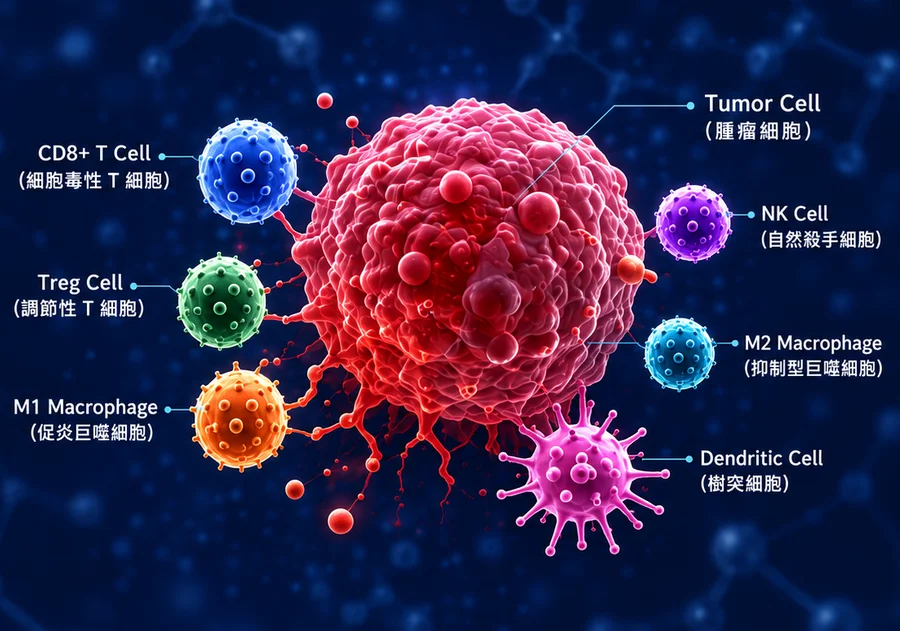
Comprehensive analysis of tumors and the immune microenvironment
Accurate Immune Assessment
Accurate evaluation of immune response and therapeutic potential
Early Immune Detection
Early detection of immune suppression and potential risk
Personalized Immunotherapy
Personalized immunotherapy strategy recommendations
Tracking Treatment Efficacy
Track treatment efficacy and monitor immune dynamic changes
Improve Quality of Life
Improve treatment success and quality of life
Suitable For
- Cancer patients
- Patients preparing for immunotherapy
- Patients evaluating treatment efficacy and tracking
- Pre-surgical or post-surgical patients
- Patients undergoing radiation or chemotherapy
- Participants in clinical trials
Testing Indicators (20+ Items)
- CD8+ T Cell Infiltration
- CD4+ T Cell Ratio
- Treg Cell Proportion
- NK Cell Activity
- M1/M2 Macrophage Ratio
- Dendritic Cell Activity
- PD-1 / PD-L1 Expression
- TIM-3 / LAG-3 Expression
- Cytokine Profile
- Immune Checkpoints
- …and more indicators
Testing Process

Sample Collection
Tumor tissue or blood sample

Flow Cytometry Analysis
Multiparameter analysis

AI Data Analysis
Immune profiling evaluation

AI Report Interpretation
Personalized recommendations

Physician Consultation
Treatment strategy development
Test Result Interpretation
Actual results will be interpreted and recommended by a professional physician based on your clinical condition.
Low
Low Infiltration
Immune cell infiltration is low. Immune suppression is high. Poor treatment response may occur.
Low-Normal
Low Activity
Immune cell activity is low. Limited response to immunotherapy may occur.
Normal
Moderate Activity
Immune cell infiltration is moderate. Treatment response may be beneficial.
High
High Activity
Immune activity is high. Better response to immunotherapy is expected.
Excellent
Immune-Elevated
Strong immune infiltration and function. Highly favorable response expected.
Clinical Applications
Immunotherapy Strategy Selection
Select the most suitable treatment strategy
Treatment Efficacy Evaluation
Evaluate immune response and treatment outcome
Pre- / Post-Surgery Assessment
Assess immune status before and after surgery
Risk of Recurrence Assessment
Estimate risk of recurrence and metastasis
Clinical Trial Support
Support patient stratification and data collection
Precision Medicine
Enable personalized immunotherapy plans
FAQ
Q.Is fasting required before the test?
No. This test analyzes tumor tissue specimens and is not affected by food intake, so fasting is not required.
Q.How long does it take to receive the results?
Comprehensive analysis is typically completed within 7–10 business days, followed by an AI-powered report with professional interpretation.
Q.Are there any additional risks associated with the test?
No. The test uses existing surgical or biopsy tissue samples and does not require any additional invasive procedures.
Q.How accurate are the test results?
The test combines advanced multiparameter flow cytometry with AI-powered analysis to provide a comprehensive and highly accurate assessment of the tumor immune microenvironment.
Q.Can this test be used to monitor treatment response?
Yes. Regular monitoring of tumor immune cell composition and function can help evaluate immunotherapy response and overall treatment effectiveness.
Q.What should I do if my results are abnormal?
Your results should be interpreted together with pathology findings, imaging studies, and clinical evaluation by your physician to develop an appropriate personalized immunotherapy strategy.