常見問題
Q1. Who is this test recommended for?
⌄
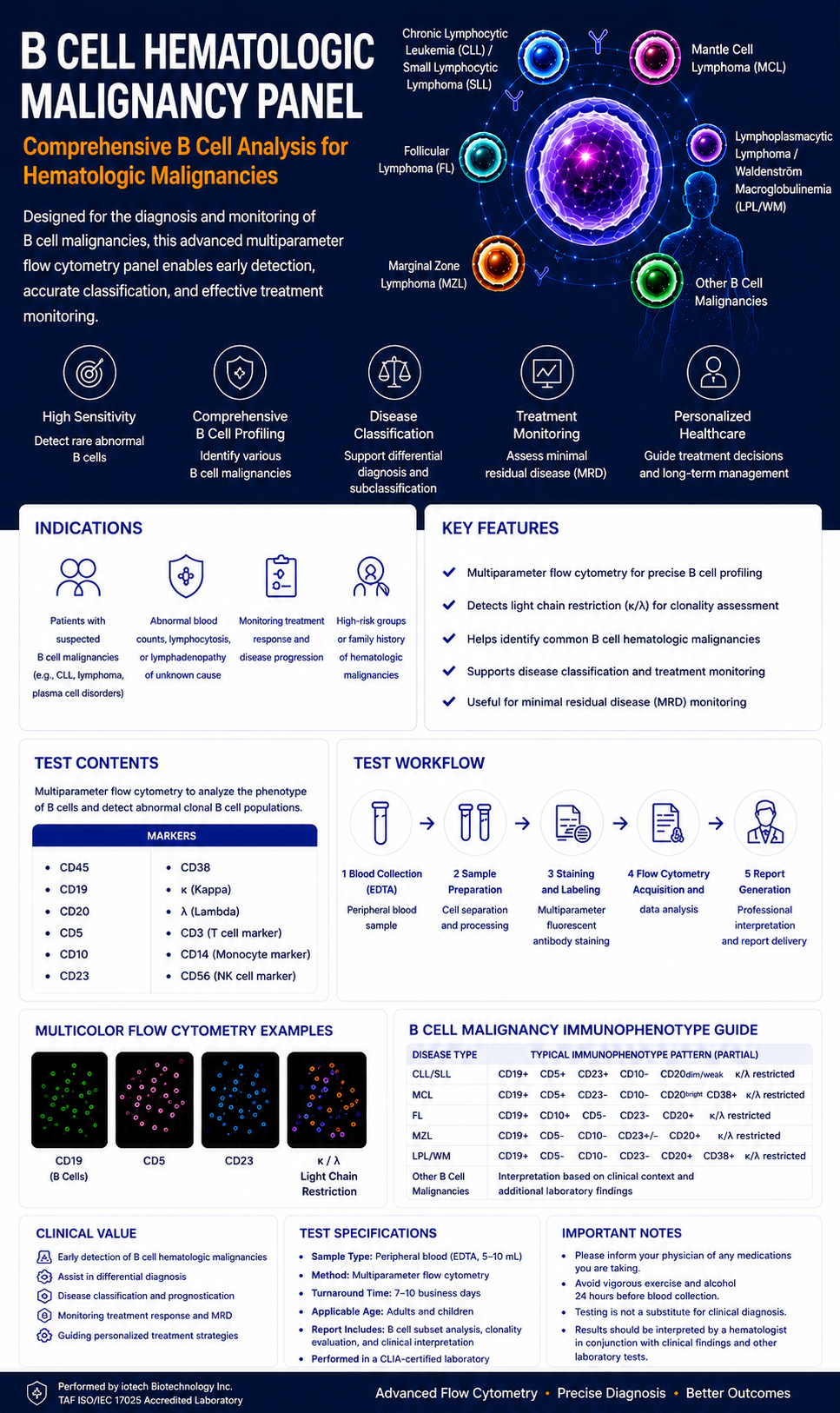
This test is recommended for individuals who are suspected of or have been diagnosed with B-cell–related hematologic disorders, including:
• Chronic Lymphocytic Leukemia / Small Lymphocytic Lymphoma (CLL/SLL)
• Follicular Lymphoma (FL)
• Mantle Cell Lymphoma (MCL)
• Marginal Zone Lymphoma (MZL)
• Lymphoplasmacytic Lymphoma / Waldenström Macroglobulinemia (LPL/WM)
• Monoclonal Gammopathy of Undetermined Significance (MGUS)
• Multiple Myeloma
• Individuals with unexplained lymphadenopathy or elevated lymphocyte counts
It is also suitable for immune monitoring before, during, and after treatment.
• Chronic Lymphocytic Leukemia / Small Lymphocytic Lymphoma (CLL/SLL)
• Follicular Lymphoma (FL)
• Mantle Cell Lymphoma (MCL)
• Marginal Zone Lymphoma (MZL)
• Lymphoplasmacytic Lymphoma / Waldenström Macroglobulinemia (LPL/WM)
• Monoclonal Gammopathy of Undetermined Significance (MGUS)
• Multiple Myeloma
• Individuals with unexplained lymphadenopathy or elevated lymphocyte counts
It is also suitable for immune monitoring before, during, and after treatment.
Q2. Can this test diagnose cancer?
⌄
This test primarily analyzes the B-cell immunophenotype.
It can help:
• Identify abnormal B-cell populations
• Differentiate between B-cell hematologic malignancies
• Assess disease activity
• Provide diagnostic information for physicians
However, a definitive diagnosis requires correlation with:
• Complete Blood Count (CBC)
• Peripheral Blood Smear
• Bone Marrow Examination
• Histopathology (Biopsy)
• Genetic Testing
• Clinical Presentation
Final interpretation should be made by a hematology specialist.
It can help:
• Identify abnormal B-cell populations
• Differentiate between B-cell hematologic malignancies
• Assess disease activity
• Provide diagnostic information for physicians
However, a definitive diagnosis requires correlation with:
• Complete Blood Count (CBC)
• Peripheral Blood Smear
• Bone Marrow Examination
• Histopathology (Biopsy)
• Genetic Testing
• Clinical Presentation
Final interpretation should be made by a hematology specialist.
Q3. What does an abnormal test result mean?
⌄
Findings such as:
• Monoclonal Kappa/Lambda light chain restriction
• Abnormal expression of CD5, CD10, or CD23
• CD20 bright or dim expression
• Abnormal CD38 expression
may indicate abnormal B-cell proliferation or the presence of a hematologic malignancy.
Test results should always be interpreted by a qualified physician together with other clinical and laboratory findings.
• Monoclonal Kappa/Lambda light chain restriction
• Abnormal expression of CD5, CD10, or CD23
• CD20 bright or dim expression
• Abnormal CD38 expression
may indicate abnormal B-cell proliferation or the presence of a hematologic malignancy.
Test results should always be interpreted by a qualified physician together with other clinical and laboratory findings.