
What Are T Cells? Types, Functions and Their Role in Cancer and Autoimmune Disease
TL;DR
- T cells (T lymphocytes) are a type of lymphocyte among the white blood cells and a key part of adaptive immunity; their precursors originate in the bone marrow and then mature and undergo selection in the thymus.
- Common types of T cells include helper (CD4⁺), cytotoxic (CD8⁺), regulatory (Treg), memory and naive T cells, and these categories overlap.
- A key task of Tregs is to limit unnecessary or excessive immune responses; their significance may differ between autoimmune disease and the tumor environment.
- Dendritic cells (DCs) and NK cells are not T cells; "TIL" describes where lymphocytes are located (inside tumor tissue), not a single category.
- Flow cytometry can be used to study the numbers and proportions, phenotypes and functions of T cells, but cancer or autoimmune disease cannot be diagnosed from T cell testing alone.
Contents
- What are T cells?
- What types of T cells are there? Understanding their roles as a defense team
- Are dendritic cells (DCs) also T cells?
- How are T cells related to cancer?
- How are T cells related to autoimmune disease?
- How can T cells be tested?
- From understanding T cells to precision immune analysis
T cells are key members of the immune system. Some attack, some coordinate the response, some apply the brakes, and some retain a memory of specific targets.
When people talk about immunity, many think of "fighting viruses" or "destroying cancer cells." But a healthy immune system does not just need to be able to strike; it also needs to identify its targets, work as a team and stop responding at the right time.
If you think of the immune system as a defense team, T cells are like its specialist members, each with a different task. Understanding how they divide the work helps explain defense against infection, cancer immunity, autoimmune disease, and research on cell testing and therapies.
What are T cells?
T cells, also called T lymphocytes, are a type of lymphocyte among the white blood cells and a key part of adaptive immunity.
"Adaptive immunity" can be understood as the immune system's ability to mount a response against a specific target and, in some cases, to retain an immune memory of it.
The precursors of T cells originate in the bone marrow and then mature and undergo selection in the thymus. This process helps build the ability to recognize targets and lowers the risk of attacking the body's own tissues.
Once mature, T cells are distributed throughout the blood, lymphoid organs and various tissues, where they take part in immune surveillance and regulation.
What types of T cells are there? Understanding their roles as a defense team
T cells can be classified in different ways according to their surface markers, function, stage of maturity and location.
The analogy below is an introductory tool to aid understanding; in reality, cell function changes with the environment and the cell's state, and not every type has only one task.
| Common name | Role in the defense team | Main function |
|---|---|---|
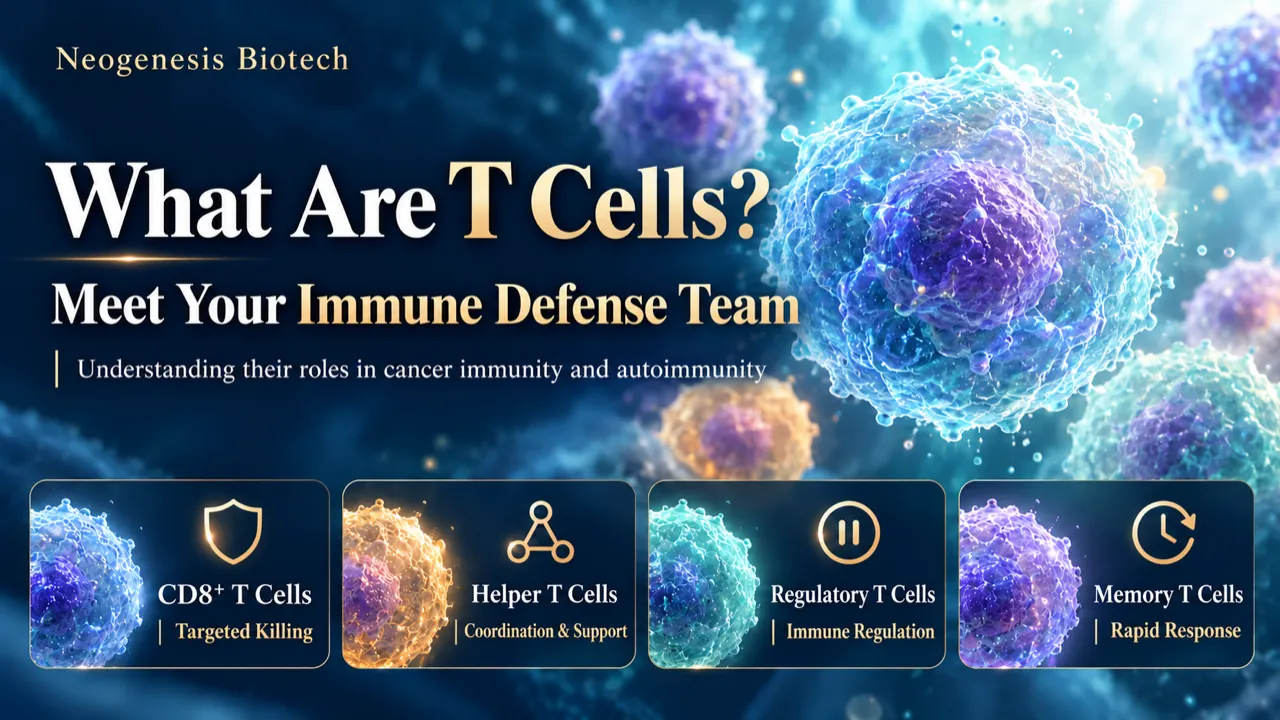
| Helper T cells, usually CD4⁺ | Coordination and support unit | Assist other immune cells and steer the direction of the response |
| Cytotoxic T cells, usually CD8⁺ | Frontline task force | Recognize and eliminate specific infected or abnormal cells |
| Regulatory T cells (Tregs) | Brakes and order-keeping unit | Limit excessive responses and help maintain self-tolerance |
| Memory T cells | Experienced reserve unit | Retain the ability to respond to a specific antigen and respond faster when they encounter it again |
| Naive T cells | Members not yet assigned a specific mission | Not yet activated by their corresponding antigen; can join a response when given the right signals |
These categories overlap. For example, both CD4⁺ and CD8⁺ T cells can form memory cells, and most Tregs are CD4⁺ T cells. So each row of the table should not be read as a separate, unrelated unit.
Helper T cells: the support unit that coordinates immune responses
Helper T cells mostly carry the CD4 marker, so they are often called CD4⁺ T cells.
Through cell-to-cell contact and signaling, they help B cells produce antibodies, support the responses of other T cells, and influence the activity of different immune cells.
Helper T cells can be further divided by function, for example into Th1, Th2, Th17 and T follicular helper (Tfh) cells. These populations take part in different defensive and inflammatory responses, and having more of any one type is not necessarily better.
CD8⁺ T cells: the frontline unit that carries out the mission
T cells with cytotoxic function are mostly CD8⁺ T cells.
When they recognize their corresponding target and receive the appropriate activation signals, they can eliminate infected cells or some cancer cells that carry recognizable features.
However, CD8⁺ is a clue to identity, not proof of sufficient killing capacity. Whether a cell can recognize its target, enter tissue and function is also affected by its level of activation, its state of differentiation and its surrounding environment.
Tregs: helping the immune system apply the brakes at the right time
A key task of regulatory T cells (Tregs) is to limit unnecessary or excessive immune responses and help keep the immune system from attacking the body's own tissues. (niaid.nih.gov)
You can think of Tregs as the brakes and order-keepers of the defense team: when action is needed, they must not stop it completely; when the mission is over, or when the response might harm the body itself, they must help bring it under control.
Tregs are therefore not simply "good cells" or "bad cells." Their significance may differ between autoimmune disease and the tumor environment.
Memory T cells: responding faster when the target appears again
After an immune response, some T cells persist for a long time and become memory T cells. When they encounter the same or a related antigen again, they can join the response more quickly. (niaid.nih.gov)
This is related to the concept of vaccines building immune memory, but vaccine protection involves more than T cells; it may also include antibodies and memory B cells.
Memory T cells also divide the work: some patrol the lymphatic system more often, some can carry out a response more quickly, and some reside in tissues for long periods.
Naive T cells: members not yet assigned a specific mission
Naive T cells are mature but have not yet been activated by the specific antigen they correspond to.
They are not "useless cells"; they are an important reserve that allows the immune system to respond to new targets. Given the right signals, some of them can proliferate and differentiate into cells that carry out a mission or form memory.
Are dendritic cells (DCs) also T cells?
No. DCs and T cells are different types of immune cells.
Dendritic cells (DCs) specialize in capturing and processing antigens and presenting relevant fragments to T cells.
If T cells are the defense team, DCs are like the intelligence gatherers and mission briefers: they provide clues about the target and also influence, through other signals, how T cells respond. This is an important link in the cooperation between innate and adaptive immunity. (cancer.gov)
The immune system also includes B cells, natural killer (NK) cells, monocytes, macrophages and other members. Each has its own tasks, and they cannot all be classified as T cells.
How are T cells related to cancer?
Some T cells can recognize abnormal signals displayed by cancer cells and take part in anti-tumor responses. But cancer may reduce immune cells' ability to recognize or attack it through various mechanisms.
The questions that tumor immunology research focuses on therefore include:
- Whether T cells can recognize the tumor.
- Whether they can enter the tumor and keep functioning.
- Whether there are immunosuppressive signals in the surrounding environment.
- How different cell populations influence one another.
This is why anti-cancer capacity cannot be judged simply by "how many T cells there are."
What are TILs, and how are they different from other T cells?
TILs are tumor-infiltrating lymphocytes: lymphocytes that have entered tumor tissue.
"TIL" describes where the cells are located; it is not a single category like CD4 or CD8. T cells in a tumor can have different functions, and not every one of them can effectively kill cancer cells.
The concept behind TIL therapy is to obtain the relevant lymphocytes from a tumor, culture and expand them in the laboratory, and then infuse them back to support the anti-tumor response. Whether it can be used, and how well it works, must be evaluated based on the specific product, indication and clinical evidence. (cancer.gov)
How are T cells related to autoimmune disease?
A healthy immune system needs to recognize threats, and it also needs to maintain appropriate "tolerance" toward the body's own tissues.
When these mechanisms fall out of balance, some immune cells may take part in attacking the body's own tissues. The cells, organs and mechanisms involved differ between autoimmune diseases, and they cannot all be reduced to "an immune system that is too strong."
In type 1 diabetes, for example, the immune system attacks the insulin-producing beta cells of the pancreas, leading to insulin deficiency. (niddk.nih.gov)
The regulatory capacity of Tregs has therefore become an important direction in autoimmune disease research. But the cause or severity of a disease, or whether a specific treatment is suitable, cannot be determined from the proportion of Tregs in the blood alone.
Tumors and autoimmune disease are also a reminder that immune health is about mounting the right response against the right target, not about raising the activity of every cell across the board.
How can T cells be tested?
A routine blood test can provide information on white blood cells and lymphocytes, but it usually cannot fully distinguish different T cell subsets.
Flow cytometry can be combined with multiple markers to study T cell composition and phenotype in more detail, for example CD3, CD4 and CD8, along with regulatory, differentiation or activation markers chosen for the purpose.
Testing needs to distinguish three levels:
- Numbers and proportions: how many cells there are and what share each population makes up.
- Phenotype: which observable characteristics the cells have.
- Function: whether the cells can carry out a specific task, which usually requires a corresponding functional assay.
For example, expressing an exhaustion-related marker does not mean that all the cells have lost their function, and identifying a Treg phenotype does not prove that the cells have suppressive capacity.
In addition, blood is only one window onto the immune system and cannot fully represent the state of a tumor or other tissues.
From understanding T cells to precision immune analysis
In the tumor immunology and autoimmune research that Neogenesis Biotech focuses on, the types, states and functions of T cells are all important subjects of study.
With an appropriate testing design, it is possible to build a pre-treatment immune baseline, track changes before and after treatment, or compare cell characteristics during culture and manufacturing.
These data can support immune monitoring and biomarker research. Developing them into a companion diagnostic (CDx) for a specific therapy in the future would require establishing the corresponding validation and clinical evidence.
This article introduces immunology concepts and research applications and is not intended as personal diagnostic or treatment advice. Choices about testing and treatment should be made by medical professionals based on each individual's situation.
FAQ
Are T cells the same as white blood cells?
T cells are one type of white blood cell and belong to the lymphocytes. White blood cells also include other kinds of cells, so the two are not the same thing.
Does having more T cells mean stronger immunity?
Not necessarily. Numbers, proportions, function, target recognition and location all matter. An increase in numbers can have different causes and cannot on its own be read as better immunity.
What is the difference between CD4 and CD8?
They are surface markers that help identify cell populations. CD4⁺ T cells are mostly involved in coordination and regulation; some CD8⁺ T cells can carry out cytotoxic tasks. Actual function still has to be interpreted together with other information.
Is it better to have more Tregs or fewer?
There is no single answer that applies to everyone. Tregs help limit excessive immune responses, but in some tumor environments they may also suppress anti-tumor responses. They must be assessed in light of the disease, tissue location and function.
Are memory T cells related to the brain's memory?
Here "memory" refers to the immune system retaining the ability to respond to a specific antigen. It is different from everyday memory or cognitive function.
Are DCs and NK cells T cells?
No. DCs are dendritic cells and NK cells are natural killer cells; they are different cell types from T cells, although they work together.
Are TILs, CAR-T cells and Tregs the same kind of category?
No. TILs are lymphocytes that have entered a tumor; CAR-T cells are T cells engineered to express a chimeric antigen receptor; Tregs are a population of T cells with an immunoregulatory role. The three are named on different bases.
Can a blood test tell me whether I have cancer or an autoimmune disease?
These conditions cannot be diagnosed from T cell testing alone. Diagnosis requires a physician's overall assessment of symptoms, medical history, disease-specific tests, and imaging or other examinations where necessary.
If my T cell test is abnormal, do I need cell therapy?
Not necessarily. The meaning of a test result needs to be established first and then evaluated against the disease and the evidence for treatment. An abnormal single value or proportion does not mean there is an indication for cell therapy.
What is the point of tracking T cells before and after treatment?
Depending on the research or clinical purpose, changes in cell composition and state can be observed and compared with symptoms, disease indicators and treatment outcomes. But cellular changes on their own cannot prove that a treatment works.
Ready to start your precision medicine journey?
Contact our experts to learn about cellular intelligence and health management.
More in Clinical Research and Trial Progress
Keep reading on related topics